
Machine Noise Control Enclosures Selection Guide
Shortlist machine noise-control enclosures using the same duties, noise concern, working positions, access and ventilation requirements, machinery interfaces and measurement plan.
Compare each proposal against the same machine duties, noise concern and working positions. Ask how loading, observation, cleaning, maintenance, heat and ventilation will be accommodated. Keep machine hazards, stopping behaviour, existing safeguards and control interfaces in the assessment, with an agreed method for judging the result.
Use the same survey information and same measurement and functional checks for the shortlist. Record what is included, which conditions were assessed and what remains unresolved; headline noise claims or generic guarding options do not establish suitability.
Compare options in the conditions where they must work — Machine Noise Control Enclosures
Plan machine noise control enclosures around your machine hazards, operator tasks, access, stopping behaviour and validation evidence. Discuss a site-specific safeguarding concept with Oxford Machine Guarding. A useful shortlist should show how every option copes with hazards and foreseeable access for machine noise-control enclosures and space, visibility and operator ergonomics.
Discuss your application
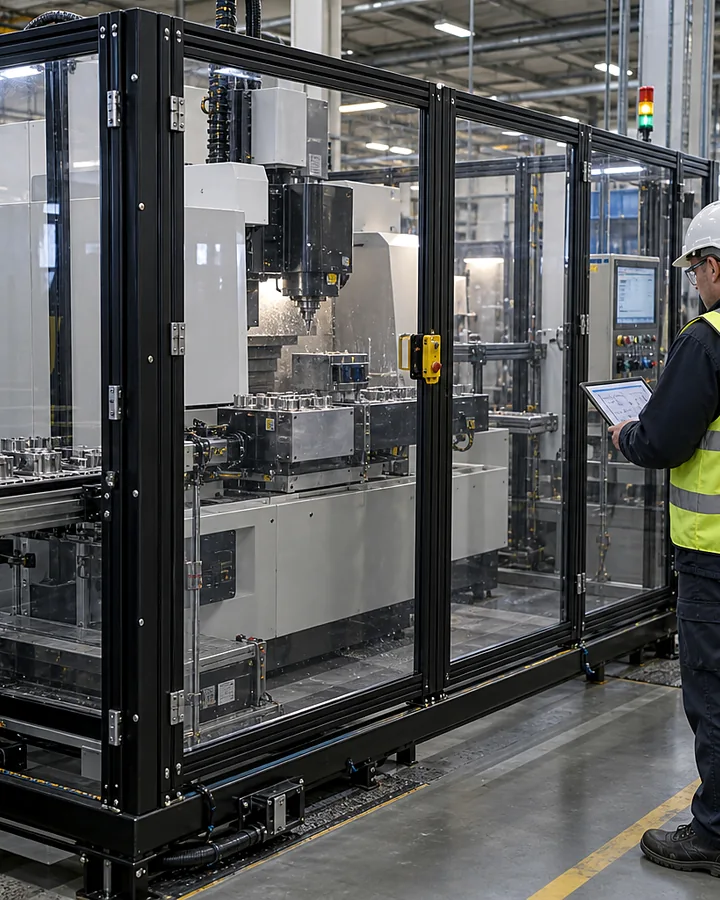
Ask every supplier the same questions
| Decision | What to ask | What to check |
|---|---|---|
| Machine and noise concern | Which machine duties and operating conditions cause concern, and where do people work? | Machine identity, operating-state record, working-position plan and available noise information. |
| Required openings and services | How will loading/discharge, services and observation be accommodated? | Layout showing required openings, connections and routine tasks. |
| Heat and ventilation | What heat and ventilation requirements must the proposal accommodate? | Agreed requirements, interfaces and a method of checking the installation. |
| Operating and maintenance access | How will normal operation, cleaning, maintenance and foreseeable intervention be assessed? | Task-based access review with visibility and ergonomic requirements. |
| Machine safeguarding and controls | What existing safeguards, stopping behaviour or controls are affected? | Defined responsibilities for machine interfaces and relevant safety-function assessment. |
| Noise and functional evidence | How will the result be measured and the installation checked? | Agreed positions, method and operating conditions, retained results and unresolved actions. |
Include simpler approaches to machine noise-control enclosures in your shortlist
| Approach | Often suitable when | Watch for |
|---|---|---|
| Noise-control enclosure | The machine duties, working positions and proposed installation can be defined. | Resolve heat/ventilation, openings and access, and agree measurement of the actual result. |
| Control noise at its source | A competent review can identify practical machine or process changes. | Assess suitability and effects on production and maintenance before committing to a change. |
| Workplace layout or barriers | The noise sources and positions of people can be assessed together. | Review the actual working arrangement and the result; retain any separate machine-safeguarding duties. |
Pause before choosing when…
- Only perfect or hand-selected examples of safeguarding existing machinery for machine noise-control enclosures are available.
- No one has defined how risk-reduction and validation evidence will be evaluated.
- The normal range for hazards and foreseeable access for machine noise-control enclosures is described only as “usually fine” but has not been bounded.
- Your operator, cleaning, maintenance or recovery access has not been considered.
- Quoted performance depends on another machine or data source that is not included.